Thursday, July 28, 2016

R.I.P. Hastings

 July 27, 2016
Originally printed in the Batesville Daily Guard

By the end of the year, a store that became sort of an institution for collectors of music, books, games, movies and toys will be gone.
Last Thursday, Hastings announced that it could not find a buyer and would thus be liquidating its inventory. For many people in small cities and towns, it means the end of the only place that allowed them to indulge interests that they would otherwise have to go to larger towns for.
For those who came of age after the internet changed society, that may not be so much the case. After all, they grew up during a time where there’s a world of options at their fingertips. And let’s face it, those of us who used to show up at Hastings the day we got paid (or got an allowance for some) are probably buying music and books on Amazon, eBay or even Barnes and Noble now. 
Nothing wrong with that. But it is still sad that Hastings is going to go. After all, stores like Hastings provided fandom and collectors a place to socialize and converge where there would otherwise be none.
Plus, when you were shopping, or even just browsing, for things on the shelf, you often inadvertently discovered something new. It might have been cover art or a title that caught your eye, but this other CD, DVD or book was something you wanted to know more about. That was part of the joy of getting out of the house and shopping.
What killed Hastings?
Failing to adapt, of course.
After all, it never really shifted its models to compete in the digital realm. You couldn’t go to Hastings online and download an album or book, like you can at other digital vendors. It didn’t have an answer to the Kindle or the Nook, which might have killed the market as far as printed books, but led the way to an explosion of digital reading.
The digital music and movie markets of course, were already dominated by the likes of iTunes, Amazon and others. Even if Hastings tried to jump in, it’s questionable what it could have offered that wasn’t already elsewhere.
So, in a way, it shouldn’t be too much of a surprise that it would eventually die. But, it’s been a long death. The company hasn’t increased its profit in years, hanging on to life through the sale of collectibles and licensed products, two things that just couldn’t make up for the profits that book, DVD and CD sales used to provide.
Hastings’ closing will leave a void. After all, we might do a lot of shopping online, but many of us also still like to go into stores and browse, whether it’s to kill time at lunch or just get out of the house. Sometimes we still learn about something new just by seeing it on the shelf. With Hastings gone, much of that will be gone in small towns like Batesville.
Sure, there might be a few small mom and pop stores to open in its wake. But it won’t quite be the same and it’s a very big “might” considering the lack of profitability when it comes to physical entertainment media nowadays.
Time will tell though. With this former giant slain, we might see a new life for the small speciality stores.
Or we might just see the digital giants simply get bigger.
Follow Joseph on Facebook or Twitter.

Tuesday, July 26, 2016

Twitter needs to do some busting of its own

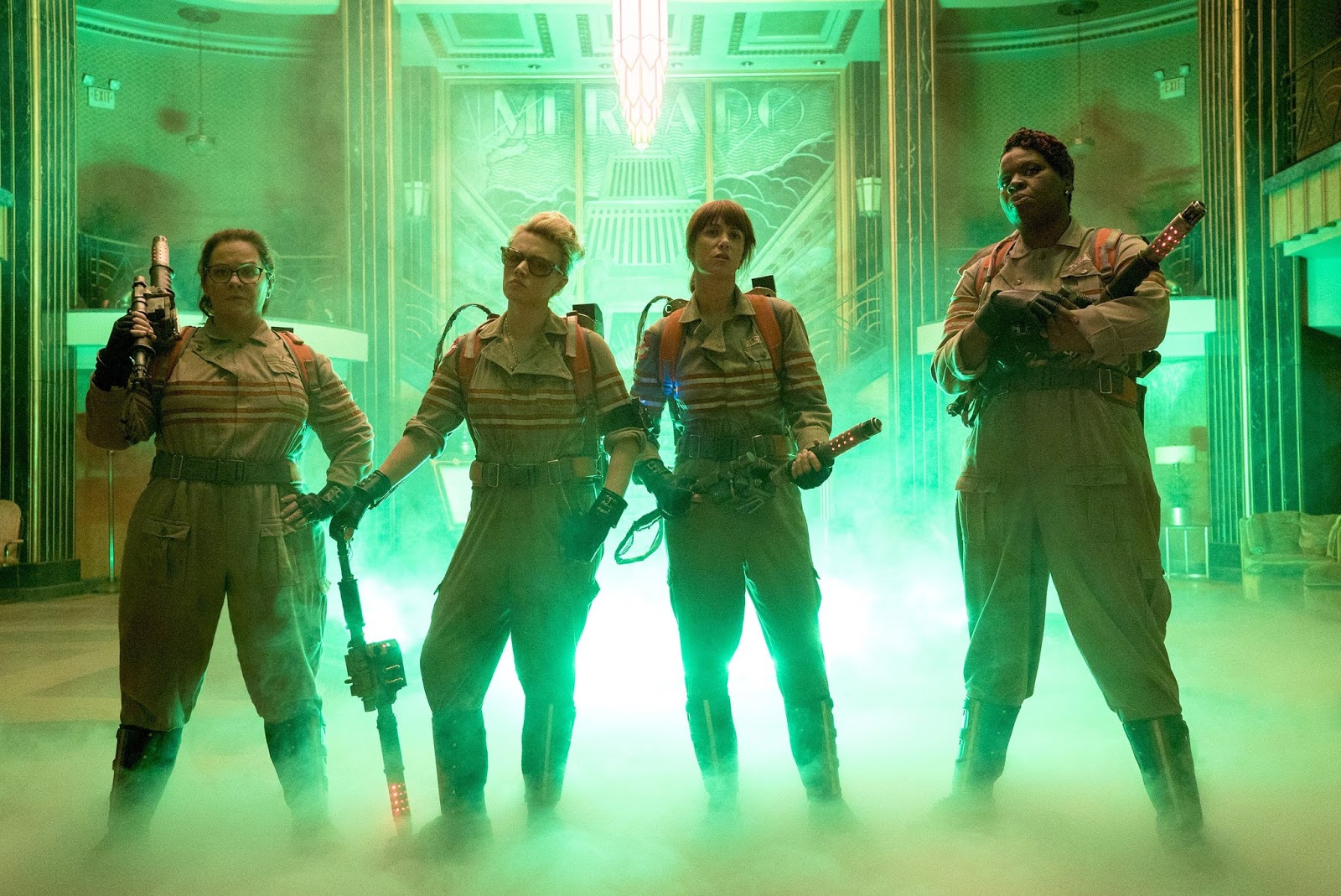
Melissa McCarthy, Kate McKinnon, Kristin Wiig 
and Leslie Jones played the Ghostbusters in its 2016 rebo
As everyone who has a social media account probably knows by now, and this is probably ancient news by now, Ghostbusters actress Leslie Jones was cyberbullied on Twitter.

The cyberbullying, which is really just another name for harassing and intimidating people on social media, consisted of messages to Jones that were racist and sexist in nature. It was pretty nasty and much of it will leave a person wondering why and how people say such horrible things and at the same time feel justified in doing so.

Jones decided to make some of these posts public, sharing them to her Twitter feed. Her intent was meant to shed light on the sort of harassment that she, women of color and women in general often face when it comes to social media.

In some ways she was successful. A dialogue started and one of the people accused of instigating and encouraging the whole thing, alt-right blogger Milo Yiannopoulos, got a lifetime ban from Twitter.

But, of course, sharing those posts publicly also brought even more harassment. For many Internet trolls, getting a response from a celebrity is the pinnacle of trolling. Having the celebrity share the post publicly is like an actor or director winning an Oscar.

Sure, when I brought up that Jones responding to and sharing these posts started a piranha-like feeding frenzy, I was criticized by angry supporters. Since nuance is not a thing on the Internet, I was not saying that she should ignore them. I wasn't even saying she shouldn't share the sort of harassment sh was getting. What I didn't agree with was the fact that she actually chose to interact with them, directly responding to them on her Twitter feed. 

By choosing to respond to them, either with her own insults or castigations, Jones essentially dived into a swimming pool full of glue. By doing that, she only made things stickier the further she waded in and allowed the people harassing her to redefine it as a “free speech” issue. Now, the hashtag #freemilo has become a thing, turning a guy that most people never heard of into an Internet celebrity and the face of the “fight politically-correct censorship” movement.

Part of the reason trolls do what they do is because they are anonymous. They can say anything they want, short of threats to the President or terrorist attacks, without repercussions. From this veil of anonymity, they can indulge their frustrations and prejudices, unleashing them in an onslaught of bile without fear of having to own up to them. Twitter is exceptionally bad for this, while Facebook is less so since it requires people to use actual names … not that there's ways around that too.

I'm usually pretty entertained by insults directed toward me. As a columnist, it makes me feel like I've made an impression. But at the same time, I'm white and male, which means I'm not the usual target demographic for trolls. As we learned with the whole Gamergate fiasco, women get the worst of it from trolls. It goes both ways, since Yiannopoulos supporter Kassy Dillon appears to be getting online harassment as well, as she has shared ones saying she should be killed or kill herself.

Gamergate was the name for an online war that started in 2014. As many people outside the gaming and Internet world were left scratching their heads about why it was a big deal, an online campaign was launched that targeted several women in the video game industry. 

The ignition point was a blog post by a former boyfriend of game developer Zoe Quinn accusing her of entering a relationship with a journalist in exchange for positive coverage.  Those who supported the ex-boyfriend organized themselves under the Twitter hashtag #Gamergate and began harassment campaigns not only against Quinn, but also prominent women developers and bloggers. The attacks were coordinated through forums and included doxing (researching and broadcasting personally identifiable information about an person). threats of rape and death threats.

Gamergate highlighted why often times, trolling is not something that can be ignored. It was a situation that not only saw women targeted with online harassment, but also threats that impacted their real lives. Many of the women involved had their physical addresses released as well as their phone numbers. It essentially crossed the line into stalking and for many of them, it was even worse because there was no way to tell if someone was actually out there, waiting to harm them or not. They couldn't be sure if the ghosts were figments of their imagination or if they were actually out there, hiding in the shadows, waiting to harm them.

So, that's why it's wrong to dismiss online harassment as something that can “just be ignored.” Particularly when it comes to women, who are disproportionately the targets.
The question is “what can be done about it?” That is what really seems to elude people right now.

The thing is, if nothing is done, Twitter will pay the price. It's still the go-to as far live feed for mainstream and online media, the coverage of the Democratic and Republican convention is an example of that. But how much longer before an alternative steps up and offers something Twitter doesn't: a willingness to crackdown on trolls. They say people vote with their feet and the principle holds true on the Internet, except that people vote with their clicks.

Follow Joseph on Facebook or Twitter.

Thursday, July 21, 2016

‘Killer’ robots can save lives

July 21, 2016
Originally published in the Batesville Daily Guard
The MARCbot has been used to kill,
but don't forget it saves lives too.


When Micah Xavier Johnson opened fire on police in Dallas after what had been a peaceful protest, killing five officers, he created a night that would live in infamy for many years to come. Aside from his planned assassination of police officers and intent to further widen his terrorist activity, it’s the method of how he was killed that will probably have the longest-lasting impact. 
As most people know, Johnson was killed by a bomb delivered to him by a remote-controlled robot.
This is the first time in American history that a robot has been used to kill a person on U.S. soil. It sets a precedent and will probably serve as the go-to case when it comes to using robots to kill in the future.
Sure, robots have been used for years by police forces, mostly for diffusing or removing bombs without putting human lives at risk. They’ve also been used, like drones, for surveillance of suspects.
The use of a robot to kill someone, though, has many people truly frightened.
“Agents of the state decided to kill a suspect on the scene without a trial and at a distance when perhaps other options were available,” says Sean Illing, Salon staff writer and a veteran of the U.S. Air Force. “A death-dealing robot is a weapon of war, not law enforcement.”
There is some truth to that. The robot used by Dallas Police, believed to be a MARCbot, has been already been used in Iraq to achieve similar goals. In Iraq, jury-rigged MARCbots were used to deliver Claymore anti-personnel mines into potential ambushes.
Of course, blowing up said robot costs thousands of dollars. A price that the military can absorb with little issue. Your typical police station not-so-much, which means that they would probably only be used in such a fashion when the need calls for it.
Cost aside though, is this something we should be afraid of? Will it kick off an era where the police and the military are nearly indistinguishable?
I don’t think so.
Think about it: Robotic and drone technology is taking off. It was recently reported that Rolls Royce is planning to have its entire cargo fleet operated by drone technology by 2020. Jaguar is creating a fleet of 100 semi-autonomous Land Rovers over the next four years for experimental purposes. In the coming years, we can probably expect news of more transporters getting on board with that, eventually making most of the shipping in the developed world done by drones.
Moving forward with this technology, there’s many opportunities to apply robotic and drone to officer safety and in turn, public safety.
Imagine in the near future, that instead of a police officer coming to your window during a traffic stop, you are greeted by a hovering drone. The drone, which would likely be deployed from where the officer’s trunk space is now, would likely be capable of either scanning your license, insurance and registration or simply carrying the documents back to the officer. 
On its face, some people might dismiss that as a waste. Why buy expensive drones when a human being can do the job?
Why? Because traffic stops are often the most dangerous situations for both police and civilians. Setting aside all the accident-related fatalities from traffic stops, like police being hit by cars, more police were killed intentionally during traffic stops than any other situation in 2015.
Not only is the officer putting themselves in danger by going into what is often an unknown situation, but the civilian is also at risk, as we have unfortunately found in past cases. Some people who don’t know better get out of their car and approach the officer, others can make a movement that can be misinterpreted, especially in an already tense situation.
Applying robotic and drone technology to this situation can save lives. Eliminating those moments when an officer enters a situation blind also reduces the chances an officer, or civilian, will be killed in them.
This is just one of the many potential ways robotic and drone technology could be used to save lives. But whatever the application, it’s about keeping one side out of harm’s way.
Similarly to the delivery of a bomb in Dallas, a drone could probably be adapted to non-lethal means of neutralizing potentially bad situations. Whether it be stunning suspects with Tasers or deploying tear gas in riot or hostage situations, robots and drones are highly adaptable depending on the need.
But of course, like Dallas, the technology could be adapted to kill. When there’s an active shooter, a drone of some sort, armed with a gun, could be used to take out the perpetrator without officers getting into the line of fire. While this is troublesome for many people, we got to remember that we’re often talking about people who have the intent of killing as many people as possible.
But all of this is probably quite a few years away. Between now and then, will be the time it’s developed and the discussion of the moral and legal issues are discussed.
For now, robots and drones are already a part of policing in the U.S. They are mainly used for surveillance and searches. Unlike a human, a drone can be deployed into the air within minutes and get closer to the subjects. Whether it be accidents or suspects on the lose, a drone just allows the authorities to get a closer look with relatively little risk to themselves. Since they come in a variety of shapes and sizes, not to mention some can hover, they’re excellent tools for observation.
And don’t forget, robots have been serving for years when it comes to not only surveillance, but protecting people from bombs as well.
It all may violate Isaac Aasimov’s rules of robotics, but reality is not as morally cut-and-dry like fiction. If you look at it from my perspective, the use of robots in war and policing have probably kept more people from dying than if they weren’t available. Its continued use will probably continue cut the human toll in unfortunate conflicts in decades to come, whether it be through law enforcement or the military.

Friday, July 8, 2016

Who are citizen journalists?

By Joseph Price • July 8, 2016
Citizen journalism encompasses a broad scope,
 both positive and negative.
Originally published in the Batesville Daily Guard
Over the last decade or so we’ve heard a lot about citizen journalists.
Now, it’s a term that should really be simple. I’m a citizen and earn my living by reporting news from the community, state and country in which I live. That should qualify me and the broad swath of people who work on local, state and national newspapers, magazines and TV channels as “citizen journalists.”
But, with the onset of the internet, it seems to have taken a new meaning.
According to the definition on Wikipedia, which we all know to be a reliable source, a citizen journalist is someone “playing an active role in the process of collecting, reporting, analyzing, and disseminating news and information.”
Journalism professor Jay Rosen further expands that by adding “when the people formerly known as the audience employ the press tools they have in their possession to inform one another, that’s citizen journalism.”
Now, that actually sounds like amateur journalism to me, since many of them are not making a living as journalists or work in the journalism field. But, there’s nothing wrong with that.
After all, what we call citizen journalism today has been central to breaking news all over the world or giving us a fuller picture of events, often where professional journalists cannot get or were simply unaware of. It’s citizen journalists that brought us the images from the protests that led to the overthrow of the Egyptian government, footage of the destruction caused by ISIS upon ancient landmarks in Iraq and the torture of animals at the Yulin Dog Meat Festival in China. Thousands of images generated by your everyday nonjournalists have been key to informing people and getting them to act.
A lot of amateur journalists put their lives at risk and face social ostracization for getting information out to the rest of the world. In turn, they’ve become key to getting breaking stories out or grabbing the attention of the wider press and public.
They’re journalists, even though they may not do it for a living. “Amateur” after all doesn’t mean “wannabe” or “unskilled.” It just means they’re usually people who don’t make a living at it. But that doesn’t mean they don’t have a role.
But on the other hand, there are a crop of people who call themselves “citizen journalists” who really don’t do any of that. Instead, you’ll find a lot of so-called journalists trying to pass opinion off as news. Many times, they don’t even bother doing their own reporting, relying on snippets borrowed from articles wrote by journalists to sprinkle within their own opinion pieces, under the guise of “analysis.” 
That’s not unknown in the internet age. But, akin to passing a secret around an arena full of people, the truth gets lost in a lot of noise and the internet is the largest arena there is.
Case in point, the recently bankrupt Gawker which thrived on that sort “citizen journalism.”
Particularly, its Gawker Stalker feature, which existed on the page in the mid-to-late 2000s.
Gawker Stalker was a weekly roundup of celebrity sightings in New York. Instead of using traditional gossip or celebrity reporters, Gawker relied on its readers, usually through messages by text from cellphones. Gawker Stalker was frequently updated, and the sightings were displayed on a map. Although it wasn’t in “real time” feature, it sparked criticism from celebrities and publicists for encouraging stalking.
It all culminated with a confrontation between then-Gawker Editor Emily Gould and Jimmy Kimmel, host of “Live With Jimmy Kimmel.” 
Kimmel claimed Gawker posted information that could potentially assist real stalkers, adding that the website could ultimately be responsible for someone’s death.
But one of the nastier things Gawker Stalker allowed for was speculation and insinuation. One poster had said that Kimmel himself “looked intoxicated” in a sighting, in which he was returning from a child’s birthday party. 
Kimmel brought this potential libelous remark up, which Gould actually defended. 
“There’s a whole other aspect of our website that doesn’t have anything to do with the Stalker Map,” Gould told Kimmel. “But what the Stalker Map is citizen journalism. People don’t read with the expectation that every word of it will be gospel. Everyone who reads it knows that it isn’t checked at all.”
Not too terribly long after, Gawker Stalker’s map function disappeared and now the link just leads to a celebrity news page.
That interview pretty much sums up my problem with this version of so-called “citizen journalists.” They aren’t professional, they don’t answer to anyone and they often don’t have an obligation to be fair. There’s no accountability and there’s no “extra layer” between them and the page, which editors of varying stations usually provide. That’s why professional journalism is also called “collaborative journalism.”
In collaborative journalism, you have a newsroom and more than one person working to make sure the product is as factual and as fair as it can be. There are varying levels of knowledge and experience, but the collaboration brings that together, usually between editors, reporters and citizen journalists.
Often, with many of those who call themselves “citizen journalists” there is no obligation or motivation to be fair. Their idea of analyzing is often peppering a story with insinuation and speculation, usually in favor of their own biases. Sure, there are fans of this, look at the success of sites like Gawker, the Huffington Post and The Blaze, but do those sites really help people make informed opinions? Are they trustworthy enough to give a person a broad enough view of the subject at hand? Usually not; their goal is to get hits on social media, not inform.
As journalists, we know it’s our job to inform you. With the information we gather and analyze, the hopes are you’ll have informed opinions and make informed choices, at least learn something. In order to do that properly, we have to be fair and set our personal opinions, and often feelings, aside. Sometimes it’s difficult, but we do our best.
Plus, we need you to keep coming back, which means gaining your trust. Our livelihood depends on it. We are professionals after all.
Follow Joseph on Facebook or Twitter.

Wednesday, July 6, 2016

Monthly Mixtape: Faith No More

Faith No More's Sol Invictus lineup. From left: Jon Hudson,
Billy Gould, Mike Patton, Mike Bordin and Roddy Bottum.
So, this is the first in a monthly feature I’m essentially doing for the fun of it, which I call the “Monthly Mixtape.” And yes, I know that nobody has used tape in a while. Anyway, with “Monthly Mixtape,” I’m going to pick a certain number of songs which are personal favorites and which I feel encompass a band’s output. This month, I’ll be focusing on Faith No More.


As most people who knew me as a teenager could verify, one of my favorite bands, if not the favorite was Faith No More. Of course, I wasn’t alone. When the single “Epic” hit MTV in 1990, millions of us were hooked on its blend of heavy metal and rap. That single would launch Faith No More’s third album, The Real Thing, into the Billboard Top 200, eventually topping out an No. 11.


The band would go on to have less commercial success in its following, but more experimental, albums. The Real Thing’s successor, 1992’s Angel Dust is considered one of the most influential albums of all time now. Following two more albums, 1995’s King For a Day, Fool For a Lifetime and 1997’s Album of the Year, the band parted ways.


Faith No More’s Album of the Year lineup reunited in 2009 and put out the band’s seventh album, and first one in 18 years, 2015’s Sol Invictus. Now, the band is still active and possibly working on new songs, but that hasn’t been verified.


That was a really brief history of the band, sans the Chuck Mosley era. I will probably revisit that one, choosing four or five songs, because that time of in the band’s history sticks out on its own.

So here it is, my Faith No More Mixtape. The songs are in order from where I would put them if I were putting together an album instead of going by release date or album name. 


With the samples of elephants and a firing squad, this song is for me a perfect opening. Perfect because it lets you know you’re in for an experience, encompassing a roller coaster of sound, diving into dark depths and flying into weird highs. The album truly kicks into gear when the keyboards start, giving the impression of opening Pandora’s Box, which kind of sums up Faith No More’s output well.


This song is from the Angel Dust sessions, but was not included on the album.


2. “Epic
The song that made them famous and introduced Faith No More to a the generation of kids born from the mid-70s to mid-80s who’d go on to form their own rap-metal fusion bands. Even though members of the band tried to escape this song for years, not even bothering to play it at their “final” show prior to their first breakup in 1998.


I’m pretty sure they’ve added it to their set list since they reunited and hopefully they’ve started running away from the song. It’s easy to see why it was the perfect late-80s, early-90s hit. It mixed to rising genres, heavy metal and rap, and made them both accessible to millions. If it weren’t for this song, it’s possible none of us would have heard of this band today.


3. “Ashes To Ashes
Album of the Year was an enjoyable album, far better than a lot of the others that were being released at the time. But like KFAD-FFAL, there was just something missing. For me, the fault of both albums is that many songs never seemed to have any sort of real climax, with repeating the song’s intro or relying on Patton’s vocal stylings, to bridge the beginning and the end.


“Ashes to Ashes” is one of the exceptions as the song is tied together by one of Hudson’s few guitar solos for the band. The song is all about mood, a particularly dark one. Even though Patton writes his lyrics to be ambiguous in meaning, one gets the feeling that that they’re with a lonely person looking out the window from a dark room that they can’t leave.


4. “Midlife Crisis
Probably the band’s most unusual and by far most experimental song. Even after 24 years, I can’t think of any other song that sounds like it. This song embodies why Angel Dust is often considered the band’s best and most influential work. Patton sounds like he is singing in the style of an early-voice synthesizing computer (Remember the Tandys?) and Bordin adds a near drone like quality to his drumming, which tie this song together.


5. “Absolute Zero
A track that was left of the KFAD-FFAL album, it’s considered by many to be the best song from that session, which left those same people scratching their heads as to why it wasn’t included on the album. It’s aggressive like “The Gentle Art of Making Enemies,” which made it onto the Album, but it’s also more solid than that song. It’s about as straightforward as a rock song as you can get from Faith No More with an intro-riff that’s sure to get that head a banging.


6. “Motherfucker
Admittedly, I haven’t heard much from Sol Invictus, so it’s really hard for me to pick out one from it. Maybe it’s because I haven’t listened enough times, but not much has really stood out to me yet. This is typical of FNM, whose albums always seem to require a few listens before you can get into them. Price of being experimental I suppose.


If I were to go with one that really stands out to me right now, it’s “Motherfucker,” the first single. Yeah, the title is a bit juvenile, but at the same time, it’s a really catchy song. The band sent a message choosing to release this one: We’re back, we’re together and we’re doing what we want.


7. “The Real Thing
Probably the largest sounding song by Faith No More. By large sounding I mean that you could easily picture this song blasting throughout an arena stuffed with people. It’s also the longest song on this list, clocking in at 8:13. I chose it because it sounds like all the elements that you hear spread throughout The Real Thing album cumulates here, bringing them together on a climactic high.


8. “Last to Know
I never hear this one mentioned in lists when people are talking about the best FNM songs. It’s kind of surprising to me because I consider it the best on the KFAD-FFAL album. It’s a slow rocker and also a moving one, giving one the feeling of being on the outside trying to look in. Trey Spruance, whom Mike Patton brought into FNM from Mr. Bungle to fill in the void left by Jim Martin, shines in his solo here on an album which he is largely overshadowed. Great capper for a night of drinking alone.


9. “Cowboy Song
You know, it seems like FNM’s best material was often left off their albums. Case and point, the Cowboy Song. Musically, this pretty much dwarfs everything on The Real Thing, the time period in which this song was recorded. From its keyboard intro to Patton’s early Falsetto singing to Jim Martin’s shredding, this is everything during the Epic era turned up to 11. It’s great, it hits like a wall of sound.


10. “Jizzlober


Faith No More has wrote some pretty dark songs, but “Jizzlober” may be the darkest. Starting with a sampling of what sounds like someone wading through a swamp at night, the song turns into what could be the band’s heaviest song. The subject matter is dark, apparently about Patton’s fear of going to prison, and the music does its best to dig an even darker hole. The music is akin to taking an aural beating, it’s relentless and unforgiving, dragging you along with Patton into his nightmare, eventually ending in organ music, something one could interpret as finally waking up in the morning.

Follow Joseph on Facebook or Twitter.

Wednesday, June 29, 2016

Hubble made space beautiful for all of us

By Joseph Price • June 29, 2016
Originally published in the Batesville Daily Guard

The Pillars of Creation
When you look up at the sky at night, you see the moon, stars and the occasional red-beacon of a plane flying over head. But also up there, close to Earth but just out of sight are hundreds, if not thousands, of man-made satellites, man-made debris, a couple of space stations and dozens of space telescopes.
The most famous of those space telescopes, as far as Americans are concerned at least, is the Hubble Space Telescope, which has now been in orbit for 26 years. That’s longer than 33 percent of the U.S. population has been alive.
I was close to the end of seventh grade when Hubble was launched April 25, 1990. Of course, being 12, I wasn’t interested in the news too much back then, but I remember some coverage of it. Much of it due to Arsenio Hall deriding it for “taking the same picture” of some far off object which I forget the name of, that looked identical to one taken by a terrestrial telescope.
But unlike the Arsenio Hall Show, the Hubble telescope is still around.
Aside from a few issues in the beginning, particularly that with a flawed mirror, the Hubble telescope has helped turn space into something more than a few bright ambiguous lights in the sky.
Through the Hubble, we learned more about the age of the universe, that the rate of expansion of the universe is increasing, learned about black holes in neighboring galaxies and discovered the evidence for exoplanets around other stars.
But its biggest impact on the public has probably been its images. From the cosmic fireworks of the Tarantula Nebula to the Pillars of Creation 7,000 light years away, the universe became an amazing and beautiful place again. Now when we look at the night sky, we know there’s more up there than the white light of distant stars. Instead we can look up an imagine the millions of suns being born out of the clouds within a nebula at this moment, the terrific power of a supernova exploding and wiping out entire solar systems and galaxies colliding to become one … including our own which is on a crash course with the Andromeda Galaxy which will rock us in about 4 billion years.
It is also one of the most egalitarian projects by a space agency that I know of. Use of the telescope is open to the public, regardless of nationality or academic institution. It is accessible to amateur astronomers, who can file to use it for a few hours each cycle. It opened the door to space wide open for everyone.
And in short, it helped show us how awesome and how crowded space actually is.
With it becoming such an integral part of bringing space to the public, it’s hard to imagine that it wasn’t supposed to be up there this long.
Originally, it was expected Hubble would have a lifespan of 15 years and its last service mission was in 2009. But, showing its resilience, it continues on its mission, traveling more than 3 billion miles since it was launched almost a generation ago.
Earlier this week, NASA said that the Hubble will stay in operation for the next five years. The agency extended its contract with the Association of Universities for Research in Astronomy to support its operation at the Space Telescope Science Institute in Baltimore. The extension has moved the end of its operation from July 1, 2016, to June 30, 2021.
But inevitably, the end will come. 
The James Webb Space Telescope is set to replace the Hubble in 2018. Where the Hubble stays in low earth orbit, about 354 miles away, the JWST will be in the Earth-Sun L2 Lagrange point, 932,000 miles away. A Lagrangian point is the position in orbital configuration between two large bodies is affected only by the gravity it can maintain a stable position. The L2 is on the other side of the moon, putting the JWST somewhere between Earth and Mars most of the time. Imagine what the view will be like way out there.
JWST will also operate in the infrared spectrum, which will allow it to study the earliest parts of the universe in more detail. The Hubble observes the universe in visible and ultraviolet light.
So what happens in 2021?
Well, the Hubble will stay in orbit for a while, years probably. Based on solar activity and lack of atmospheric drag a natural atmospheric reentry for Hubble will occur between 2030 and 2040. Around the time I’m 60 years old, probably. As it re-enters, most of it will burn away, leaving just a few parts surviving the fall, which will probably be into an ocean somewhere.
It’s kind of melancholic thinking about something that has been a fixture of the sky so long falling to the sky and burning into nothingness. But I guess that’s ultimately how the Earth will turn out eventually when it’s consumed by the sun as it expands into a red giant in a few billion years. Of course, one could consider that better than the big freeze which many scientist theorize will happen when all the energy generated by suns is finally exhausted.
It’s a frightening thing to contemplate and maybe that won’t be the case. Who knows what we’ll find next, it seems some new discovery changes everything we thought we knew before before on a pretty constant basis now.
For now though, instead of thinking of where everything will go, I think it’s just better to look at the sky and appreciate that there’s more than any of us will ever see out there. And what wonder is there to life if you’ve seen everything that there is to see?

Wednesday, June 22, 2016

Primaries test endurance, patience

By Joseph Price • June 22, 2016
You could say the worst is over.
Originally published in the Batesville Daily Guard
General election season is upon us. Pretty soon, we’ll be bombarded by nonstop advertisements — not only from the Clinton and Trump campaigns, but also the U.S. Senate, U.S. House, state, county and municipal campaigns.
Sure, we’ll get a short break once the election is over with, but probably not for long. It seems that campaigns start earlier and earlier every cycle. This time around, we had candidates forming exploratory and political action committees as soon as November 2014 for this election.
The first official candidate for the 2016 presidential election, Ted Cruz, declared his candidacy on March 23, 2015. That’s 596, or 1.6 years, before the election! That early start didn’t pay off for him as no one is bothering to talk about him since he ended his campaign in May.
Of the remaining major party candidates, Hillary Clinton has been at it the longest, declaring her candidacy for the Democratic nomination on April 12, 2015, or 436 days ago, and Donald Trump declared his candidacy for the Republican nomination June 16, 2015. I might as well mention Sanders because he’s not officially ended his campaign; he’s been in it since April 30, 2015.
Of the two larger, so-called minor parties, Gary Johnson declared his candidacy for the Libertarian Party on Jan. 6, 2016, and Jill Stein declared hers for the Green on June 22, 2015.
Before this action, if that’s what you want to call debates and speeches, kicked off, potential candidates were busy behind the scenes trying to round up donors and support. Our system of election still relies on money, like most other developed countries, so we’re not unique in that. What sets us apart is that we have a system that limits donation limits but not spending limits.
Of course, there are loopholes in regards to that spending, best known as Super PACS which raise and spend as much money as they want as long as they don’t give it directly to a candidate or other political committees that give directly to candidates, nor coordinate how it spends its money with a federal candidate.
But that’s behind the scenes. The money exchanging and handshakes aren’t really that interesting to people, unless of course, somebody shines a light on some excess or finds contributors with some particularly interesting baggage.
I really lay a lot of blame on the broadcast media for making these election seasons feel so long. They’re holding the first of their numerous debates earlier and earlier every year. This year, Fox News kicked off the debate season on Aug. 6, 2015, with its Republican debate. There was so many candidates that they divided it into an opening act, featuring lower-polling candidates and a main event featuring the Top 10.
With 16 total candidates, it was the equivalent of a mosh pit where any new arrivals would find the circle too crowded to push their way to the spotlight, being shoved to the peripheral instead.
The Democrats were able to avoid much of this. They still had room on the stage when they held their first debate on Oct. 3, 2016, with just five candidates. Within just a couple of months, it was down to just two.
For me, the debates were one of the most excruciating parts of the process. Honestly, I’m hard-pressed to find one debate interesting enough to watch, let alone five or six. But, big media and political pundits love sound bytes and they got plenty of them by digging out a few minutes from each of these snoozers.
And finally, the big culprits are the primaries themselves. It seems that the states that are not Iowa, New Hampshire, Carolina and Nevada keep trying to one up each other for who can be earliest, though they can’t ever be scheduled before March. The earlier your primary, the more influence your state has after all.
So instead of having these primaries arranged in some orderly fashion that makes sense, they’re held on different days of the week, are sometimes caucuses, sometimes open or closed — just all over the place. All that seems to be for sure is that California is the last one for Republicans and Washington, D.C., is the last for Democrats.
After all, it’s pretty rare that you hear, “It’s down to what California decides!”
But admit it, by the time it’s over in June, you probably stopped paying attention. Your state primary was in March after all.
Personally, I’m not a fan of primaries. This year was a primary example (yuk yuk) of why that’s the case. It’s one of the examples of where I’d prefer either reform or things go back to the “good old days.”
By the “good old days” I’m referring to those smoke-filled back rooms where deals were made between party bosses or those battles on the convention floors between delegates who were actually members of the party.
Sure, the open primaries may be more democratic, but it’s become pretty obvious that often what the voters who turn out want and what party leaders want are often different.
It was not more obvious this year. The establishment by and large wanted someone that was not Donald Trump, while the people who turned out for primaries, who were not all card-carrying Republicans, did. There was a similar story with Clinton, the establishment wanted her, the primary voters made it not-so-clear cut.
So I often want to ask party leaders “if you don’t want these candidates then why do you let them run? If you’ve already got your preference, then why bother with a primary?”
Looking ahead, do we want this same endurance challenge in 2020 and 2024? Instead of this exhausting and boring primary season, can’t we just let the parties battle it out at their respective convention?
Maybe we can talk about that before the 2020 primary season starts Nov. 9.